
Families eventually outgrow their living spaces. Toys take over the lounge, the kitchen feels too cramped for entertaining, and the morning queue for the bathroom tests everyone’s patience. If your property is bursting at the seams this year, you are likely wrestling with a very common dilemma: do we extend, or do we pack up and move?
Here in 2026, the house extension vs moving debate carries more financial weight than it did a few years ago. Since the stamp duty nil-rate threshold dropped back down in March 2025, the upfront penalty for buying a new home has become a bitter pill to swallow. Homeowners are suddenly looking at their gardens and lofts with fresh eyes, wondering if expanding their current footprint makes better financial sense.
We completely understand this balancing act. At Nova Design and Build, our team helps London homeowners navigate these exact decisions every single week. Getting it right requires looking past the headline figures and digging into the hidden fees, local property ceilings, and long-term resale value.
To help you gain some clarity, we have put together a comprehensive comparison of costs, disruption, and returns so you can figure out your best path forward.
Quick answer: which option makes financial sense in 2026?
For most London homeowners needing an extra 20 to 40 square metres, extending is usually the more cost-effective option. The thousands of pounds you would otherwise burn on moving taxes and fees can be invested directly into the fabric of your property.
However, moving generally wins if your current home has zero room for expansion, sits in an area with a strict price ceiling, or if you fundamentally want a different lifestyle that your current postcode cannot provide.
The real cost of moving home in 2026
The asking price of a new property is only one part of the equation. Moving comes with a mountain of “sunk costs” that add absolutely zero value to your daily life. Before you call an estate agent, make sure you factor in these harsh realities.

Stamp duty land tax: This is the heavy hitter. Now that the temporary reliefs have vanished and the nil-rate band sits at a much lower threshold, buying a typical London family home will cost you tens of thousands of pounds in tax alone.
Estate agent and legal fees: Selling your current place will cost you roughly 1% to 2% of its value in estate agent fees. Add another £1,500 to £3,000 for your conveyancing solicitor and property surveys.
Removals and transition: Hiring a professional removal company in London easily runs past £1,500. You might also need temporary storage, mail redirection, and a few days off work.
The “new house” refresh: Very few people move into a new property and leave it untouched. Replacing tired carpets, repainting scuffed walls, and fixing the quirks the previous owners hid behind their sofa will quickly eat into your savings.
The real cost of a house extension in 2026
Building outwards or upwards is a fantastic way to upgrade your lifestyle, but it certainly requires a healthy budget. Construction costs have stabilised, yet quality craftsmanship commands a premium.
In London, you should expect a house extension to cost between £3,000 and £5,000 per square metre. A high-end finish with bespoke glazing and structural steelwork will push you toward the upper end of that bracket.
Beyond the build itself, you must account for professional fees. Architects, structural engineers, and building control inspectors will take up roughly 10% to 15% of your total budget. If you share boundaries with neighbours, party wall agreements can add a few thousand pounds to the tally. You should also maintain a contingency fund of around 10% for those inevitable hidden surprises, like discovering ancient plumbing that desperately needs replacing.
In our experience delivering London extensions, the biggest budget shocks usually happen when homeowners forget to factor in the knock-on effects. Knocking down a rear wall often means redesigning the entire kitchen, updating the boiler, and laying fresh flooring throughout the ground level.
House extension vs moving cost: compare like-for-like space
To make a fair financial judgement, you need to calculate the cost per additional square metre created versus the cost per additional square metre purchased.
Let us look at a highly illustrative example. Suppose you need an extra 30 square metres of space.
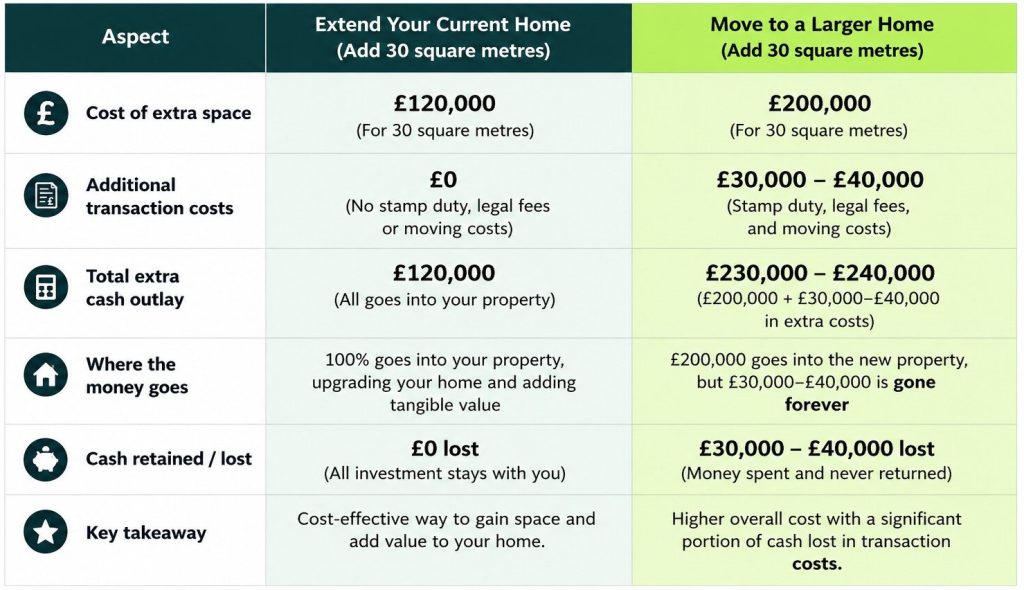
If you extend your current home, that 30 square metres might cost you £120,000. Every single penny of that money goes into your property, upgrading your kitchen and adding tangible value to your asset.
If you decide to move, buying a house that is 30 square metres larger might cost you £200,000 more than your current home’s value. You will also pay around £30,000 to £40,000 in stamp duty, legal fees, and moving costs. That £40,000 is gone forever. When comparing the house extension vs moving cost, staying put allows you to avoid throwing vast sums of cash into the transaction void.
Home renovation ROI UK: will extending your home pay you back?
Investing £100,000 into your house does not automatically increase its value by £100,000. Your home renovation ROI UK depends heavily on your local market and the specific type of project you undertake.
Every street has a “ceiling price”. This is the maximum amount buyers are willing to pay for a property in that specific location, regardless of how beautiful the kitchen is. If your home is already near that ceiling, a massive wraparound extension might not pay you back pound-for-pound when you sell.
However, certain projects historically deliver excellent returns. A well-designed rear extension that transforms a dark, cramped kitchen into a bright, open-plan dining space is a major selling point. Loft conversions are similarly lucrative because adding an extra bedroom and bathroom directly elevates the property into a higher pricing tier.
Our team frequently manages full property refurbishments tied into an extension, ensuring the entire house flows seamlessly. Cohesive design always yields a better return than a disjointed add-on.
Non-financial costs to consider
Money is important, but your sanity matters just as much. Moving away means uprooting your family, changing school catchments, and leaving behind neighbours you trust. Finding the perfect house in a competitive market can take many stressful months.
Living through a building project is no walk in the park either. Dust, noise, and temporarily washing your dishes in the bath will test your patience. A good contractor will mitigate this disruption, but you must be prepared for a few months of chaos in exchange for a custom-built home.
When a fresh start is the best option
Packing your bags makes perfect sense under certain conditions:
- Your property cannot be extended due to conservation area restrictions, listed status, or a tiny garden.
- You want a totally different lifestyle, like moving from a busy high street to a quiet village.
- Extending would push your home’s total cost far beyond the local ceiling price.
- Site access is so poor that digging foundations and bringing in materials becomes disproportionately expensive.
When extending is the smarter choice
Staying put is usually the winning strategy when:
- You absolutely love your current neighbourhood and local schools.
- Your garden is large enough to surrender some space without ruining the outdoor feel.
- You want to design a space perfectly tailored to your family’s daily habits.
- You want to avoid paying massive, unrecoverable transaction taxes.
A quick decision checklist
Still feeling stuck? Tick off the statements below to see which way the wind is blowing for your family.
You should lean towards extending if:
- You plan to stay in the property for at least another five years.
- You have a clear idea of the exact space you are missing.
- You have equity or savings to fund a build.
- You can tolerate a few months of construction noise.
You should lean towards moving if:
- You are desperate for a shorter commute.
- You need an extra bedroom but have no loft or garden space left.
- The thought of managing a building project fills you with dread.
- You are ready for a completely fresh start.
Frequently asked questions
Is a house extension cheaper than moving in 2026?
Generally, yes. Extending your current home helps you avoid tens of thousands of pounds in stamp duty and moving fees, allowing you to invest that money directly into your property.
What hidden costs should I budget for when moving?
You need to account for estate agent fees, conveyancing solicitors, homebuyer surveys, removal vans, mail redirection, and the inevitable redecoration costs once you move into the new place.
How much contingency should I set aside for an extension?
We strongly recommend holding back a contingency fund of 10% to 15% of the total build cost to cover unforeseen structural issues or last-minute upgrades to your fixtures.
Do I need planning permission for my extension or loft conversion?
Not always. Many rear extensions and loft conversions fall under permitted development rights. We can help you assess your property and handle the necessary building control and planning paperwork.
Does an extension add value to every property?
No. To ensure a positive home renovation ROI UK, you must keep your local ceiling price in mind. Adding a fifth bedroom to a street full of three-bedroom homes might not yield a full financial return.
How long does a typical extension take from design to completion?
Design and planning can take three to four months. The physical build usually takes between three and six months, depending on the complexity of the groundworks and structural steel required.
Can you live in the house during the work?
Yes, many of our clients stay in their homes during an extension. We seal off the construction zones to minimise dust and disruption, though you may need to rely on a temporary kitchen setup for a few weeks.
What is the best way to get an accurate extension cost estimate?
Online calculators can only guess. The best way to understand your real costs is to have an experienced builder inspect your property, assess the access, and discuss your specific finish requirements.
Make the right move for your home
Deciding between a house extension and moving is rarely simple. The best choice balances your emotional attachment to your area with the harsh realities of your budget.
If you are leaning towards expanding your current space, the smartest first step is understanding exactly what is possible and how much it will truly cost. Not sure which way to go? We can price up your extension options properly. Book a free survey with Nova Design and Build and let’s talk through what’s possible for your property.